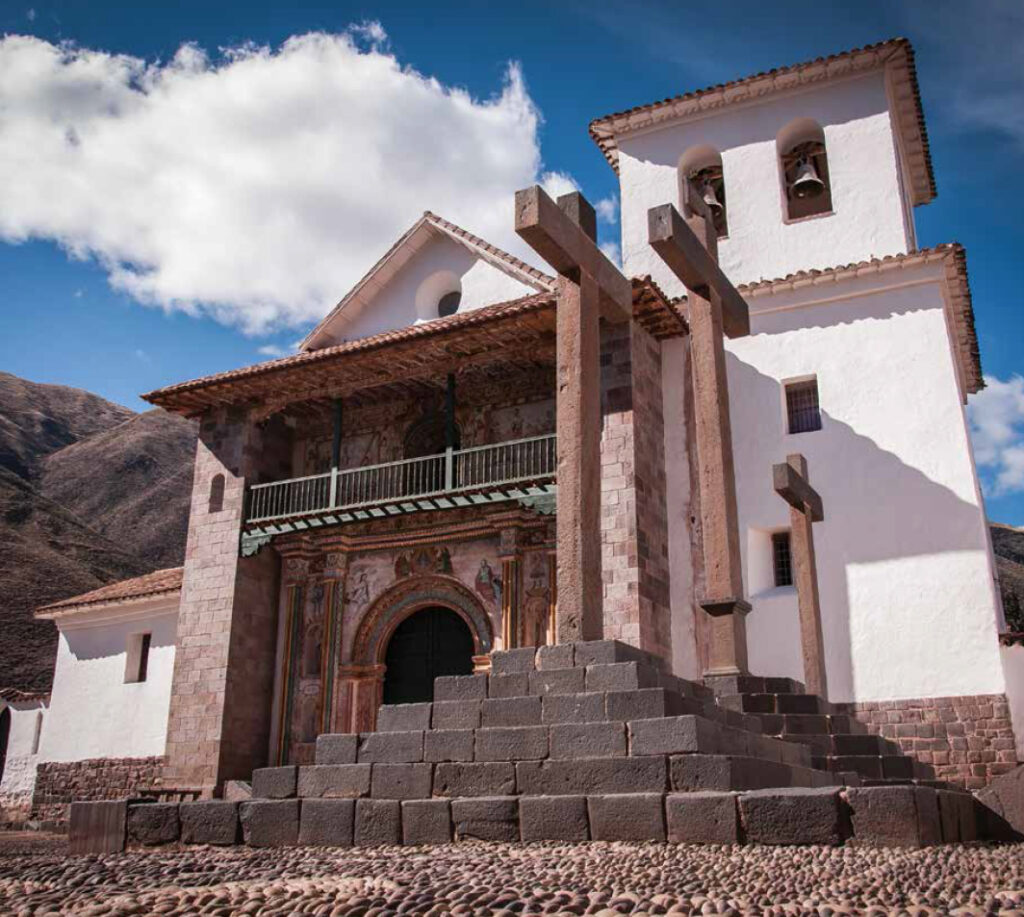
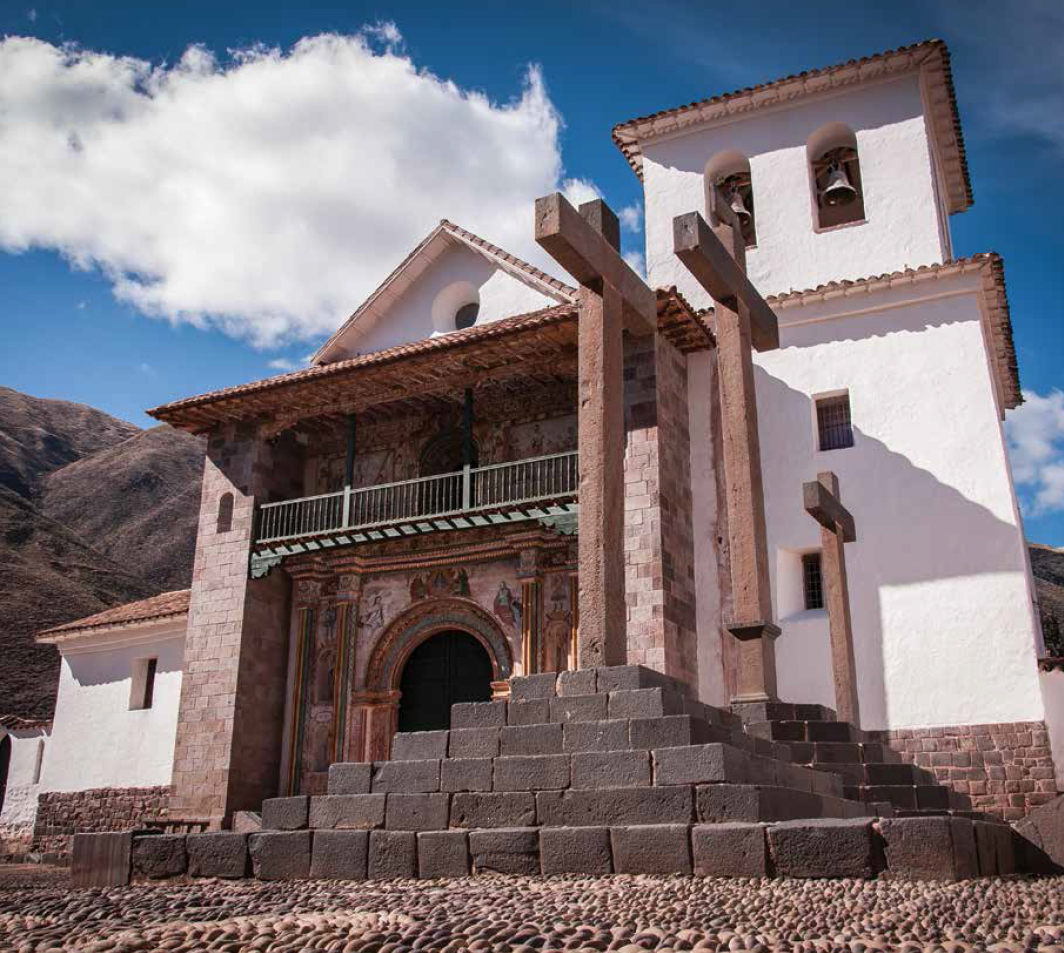
From the outside, it looks like a simple white church on a cobbled square. Then you step inside, and every wall, arch and ceiling seems to glow with paint and gold. That is the Church of San Pedro Apóstol in Andahuaylillas, a village about 40 km south of Cusco.
This guide covers what to look for inside, how to get there and when it opens. We checked every fact on 18 November 2026 against Peruvian public sources, mainly MINCETUR’s tourism inventory. One note before we start: peruvian.travel is a private, independent guide. This is not the official peru.travel site, and we have no tie to the Peruvian government.
Why Andahuaylillas is called the “Sistine Chapel of the Americas”
The nickname comes from the painted interior. According to MINCETUR, most of the murals in the nave are attributed to Luis de Riaño. The church also holds easel paintings by major 17th-century artists.
In February 2026, Peru’s tourism ministry gave the church Hierarchy 4. This is the country’s top tourism rating. As a result, it now sits at the same level as Machu Picchu and the Nazca Lines. Only 14 sites in Peru hold this rank, says the ministry.
In addition, the church has been a national heritage monument since 1960.
A short history of the church
Construction started in the late 16th century. However, the site is older than that. MINCETUR explains that the church rose over a small chapel. That chapel, in turn, stood on an Inca temple.
So the past is still visible. Finely cut Inca stones form part of the foundations and the tower base. Above them, the walls are adobe, held up by outer buttresses.
The style mixes several traditions. The façade is Renaissance, with a Roman-style triumphal arch. Meanwhile, the brick details and the carved wooden ceilings follow the Mudéjar style. The whole building is known as Andean Baroque.
What to see inside Andahuaylillas Church
The plan is simple: one long nave, four side chapels and a single tower. Yet the details are anything but simple. Here is a quick list, based on the MINCETUR record:
| Feature | What to look for |
|---|---|
| Murals | Painted walls along the nave, mostly attributed to Luis de Riaño |
| Triumphal arch | A mural of the Virgin, Queen of the Angels |
| Ceiling | A 17th-century painted wooden ceiling with leaf patterns |
| Main altar | Carved cedar covered in gold leaf, from the mid-1600s |
| Organs | Two 17th-century organs in the choir loft |
| Paintings | A Cusco School series on the life of Saint Peter |
The ceiling
Look up as soon as you enter. The ceiling beams carry carved diamonds filled with leaves. Over the main chapel, an eight-sided wooden ceiling crowns the space. Painted papal tiaras and keys appear across it. They are the symbols of Saint Peter, the church’s patron.
The main altar
The main altar has two levels and three sections. Twisted columns decorated with grapes divide them. Between the columns, you will see paintings and statues of saints in niches.
The two organs
Next, turn around and look at the choir loft. Two organs stand there. They were built in Cusco between 1606 and 1620. MINCETUR calls them the oldest in Latin America, and both still work.
In fact, the record links them to a musical first. The Hanaq Pachap Kusikuynin was played here. It is described as the first polyphonic piece of the New World. It is attributed to Juan Pérez Bocanegra, the parish priest at the time.
The paintings of Saint Peter
Finally, check the side walls. A series of Cusco School canvases tells the life of Saint Peter. Scenes include Peter escaping from prison and his crucifixion.
The square outside
Do not rush back to the bus. The church was built to take religious life outdoors. For that reason, it has an open balcony for preaching to people in the square. There were also small corner chapels where processions paused.
How to get to Andahuaylillas from Cusco
MINCETUR lists the trip from Cusco’s Plaza de Armas as 40.4 km on a paved road. By tourist minibus, it takes about 55 minutes.
The church lies on the main road south of Cusco. So, for example, you could combine it with Tipon or Pikillaqta. If you have a full day, Raqchi lies further along the same route.
MINCETUR places the church at 3,120 meters above sea level. Cusco city sits higher.
Opening hours and tickets for Andahuaylillas
According to MINCETUR, the church opens every day of the year from 7:30 am to 5:30 pm. You need a ticket to enter, with different rates for nationals, foreigners and students.
Here is what else you will find:
- Guides: available in English and Spanish.
- Food: restaurants and snack kiosks nearby.
- Other services: restrooms, books, postcards and local crafts.
The church is looked after by the SEMPA association. The ministry says the building is in very good condition. Also, it received more than 100,000 visitors in 2025, according to SEMPA.
Before you head out
Andahuaylillas is a short trip with a big payoff. First, plan a half day from Cusco. Then give yourself time to look up at the ceiling and back at the organs. Finally, step outside and see how the church opens onto the square.
If you would rather have transport and guides arranged for you, look at these tour packages for Cusco and Machu Picchu. Either way, Andahuaylillas is worth the detour.