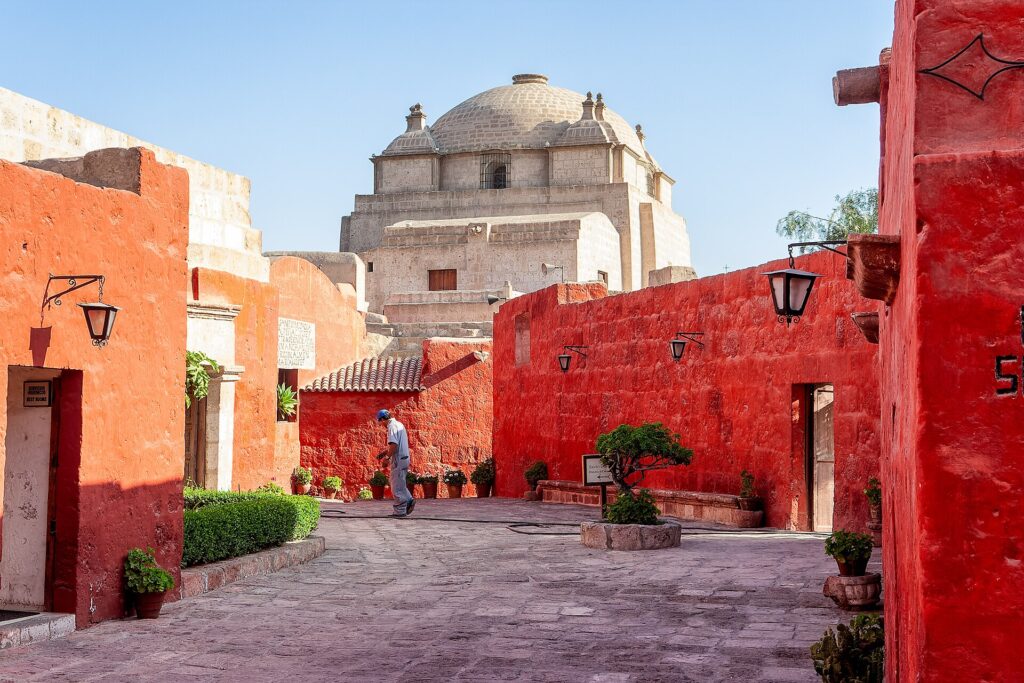
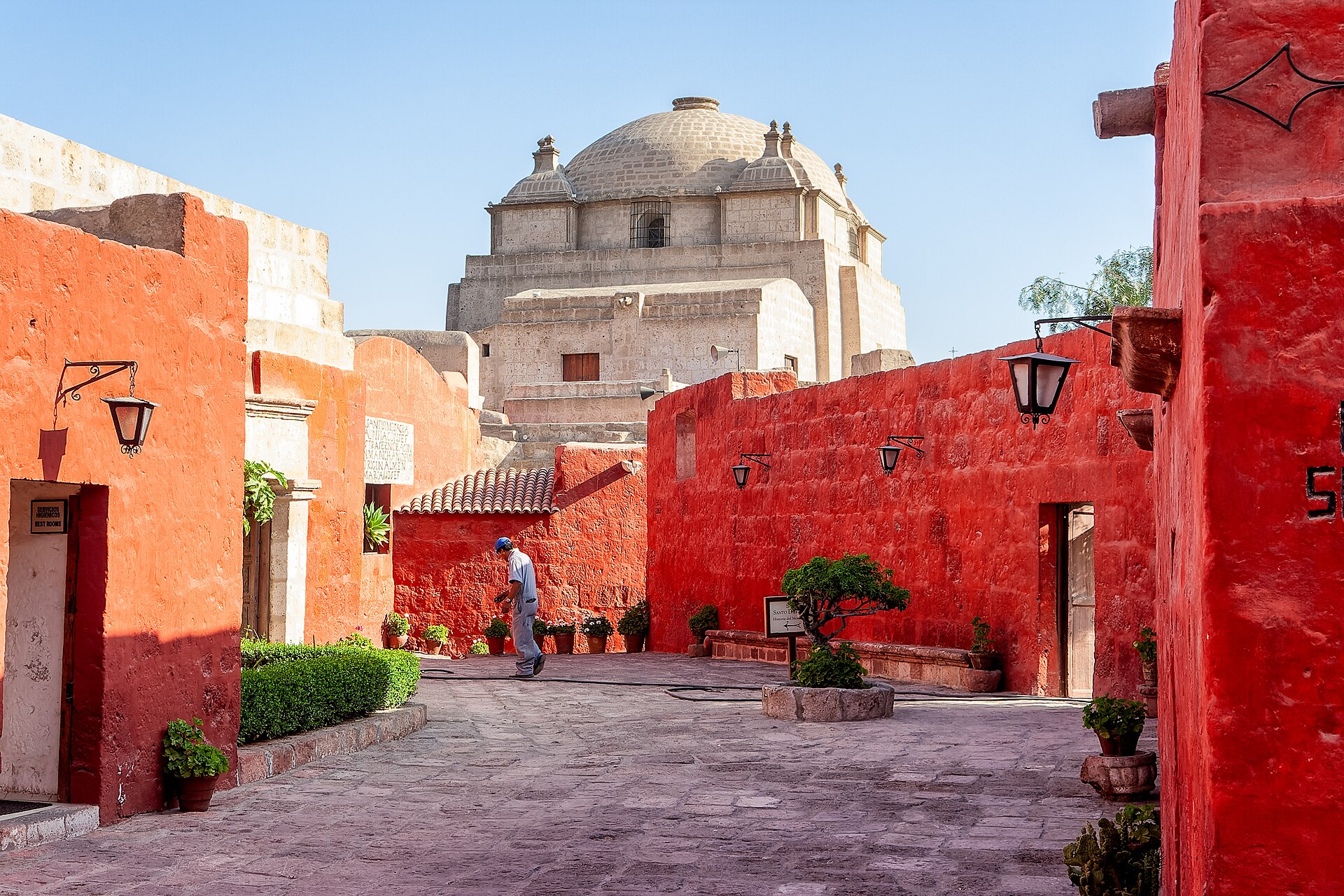
For almost four centuries, the gates of Santa Catalina stayed closed to the outside world. Today you can walk its narrow streets, painted red and indigo blue, just two blocks from Arequipa’s main square.
This guide is for first-time visitors to Arequipa. It explains what the Santa Catalina Monastery is, what to see inside, when to go and how to plan your time. All facts come from the monastery’s official website, checked on 13 November 2026. One clarification before we start. We write peruvian.travel on our own for visitors from abroad; this is not the official peru.travel site.
Santa Catalina Monastery at a glance
The monastery was founded in 1579. According to its official history, a woman named María de Guzmán gave her fortune to create it. She dedicated it to Saint Catherine of Siena.
It covers about 20,000 square meters. Because of its size and layout, the site calls it “a city within the city”. Its builders copied the street plan of colonial Arequipa, so you walk through lanes, cloisters, squares and small houses.
Like much of old Arequipa, most of it is built with sillar, the pale volcanic stone of Arequipa. However, many walls are painted in bold colors, which makes it a favorite place for photos.
It is still a living convent. In fact, the official site says that spiritual life continues behind its walls today. Also, Peru declared it national cultural heritage in 1944. It is part of the Historic Centre of Arequipa, which UNESCO listed as a World Heritage Site in 2000.
What to see inside Santa Catalina Monastery
The official map lists 32 spaces in a suggested order. You can follow it, or simply wander. Here are some highlights described on the website:
| Space | Why it stands out |
|---|---|
| Cloister of the Orange Trees | Named after its orange trees; 381 m² with indigo blue walls |
| Toledo Street | Called the colonial heart of the monastery |
| Granada Street | Its far end is one of the most photographed corners |
| Zocodover Square | A small square framed by red walls |
| The Great Kitchen | A 17th-century building that was the first chapel |
| Main Cloister | The largest cloister, 753 m², built between 1715 and 1723 |
| Pinacoteca | An art gallery with 92 colonial paintings |
The Pinacoteca
Next to the cloisters, the gallery fills three rooms with works of the Cusco School. Besides, the same rooms also host baroque concerts, according to the site.
The story of Sister Ana
Ana de los Ángeles lived from 1602 to 1686. She was a Dominican nun, a mystic and a prophet. In 1985, Pope John Paul II beatified her. Today, you can see her cell and a small oratory with objects linked to her life.
Everyday life of the nuns
Look out for the cells, the laundry area and the nuns’ bath. Each one shows how the sisters lived. For example, the site explains that the first nuns handed over a dowry when they took their vows.
When to visit Santa Catalina Monastery
First of all, the monastery is open every day. On most days, the doors open at 9 in the morning and close at 5 in the afternoon.
On Tuesdays and Wednesdays, the doors stay open until 8:00 pm. On those days, the ticket office and last entry close at 7:00 pm. As a result, those two days are the ones the site lists for a night visit.
However, it closes on three days a year: Good Friday, 25 December and 1 January.
There are also theatrical night tours, in which actors in colonial dress tell their stories. However, these only run on set dates, mostly in July and August, and they are in Spanish only.
How long to stay and other tips
Plan about 1.5 to 2 hours on your own, or about 1 hour with a guide. Here is what else the official site says:
- Guides: independent professional guides work at the entrance. They speak Spanish, English, French, German, Italian, Japanese and Portuguese. Guiding is optional and is not included in the ticket, so you pay the guide directly.
- Tickets: you can buy them online or at the entrance. Cards such as Visa, Mastercard and American Express are accepted.
- Photos: photography is allowed, but without flash indoors.
- Lockers: lockers near the entrance let you leave bulky bags and backpacks.
- Café: a café in the middle of the route serves traditional Arequipa sweets made with the nuns’ old recipes.
- Pets: pets are restricted. Only service animals may enter, with accreditation.
Finally, the address is Santa Catalina 301, in central Arequipa. From the Plaza de Armas, it is a short walk of two blocks.
Plan the rest of your trip
Santa Catalina fits easily into a first day in the city. After that, many travelers head to the Colca Canyon. Our Arequipa and Colca Canyon guide covers both.
Since Colca and Puno lie high in the Andes, first read how to handle altitude sickness in Peru. If you want a ready route, see our 14-day itinerary through Arequipa, Puno and Cusco. For the Inca heartland, Fullviajes sells English-language tour packages to Cusco and Machu Picchu.
Before you head out
Santa Catalina is more than a convent. It is a small colonial town, with its own streets, kitchen and art gallery.
So give it time. If you can, go on a Tuesday or Wednesday afternoon. Then hire a guide at the gate, and stay until the light changes on the red walls.