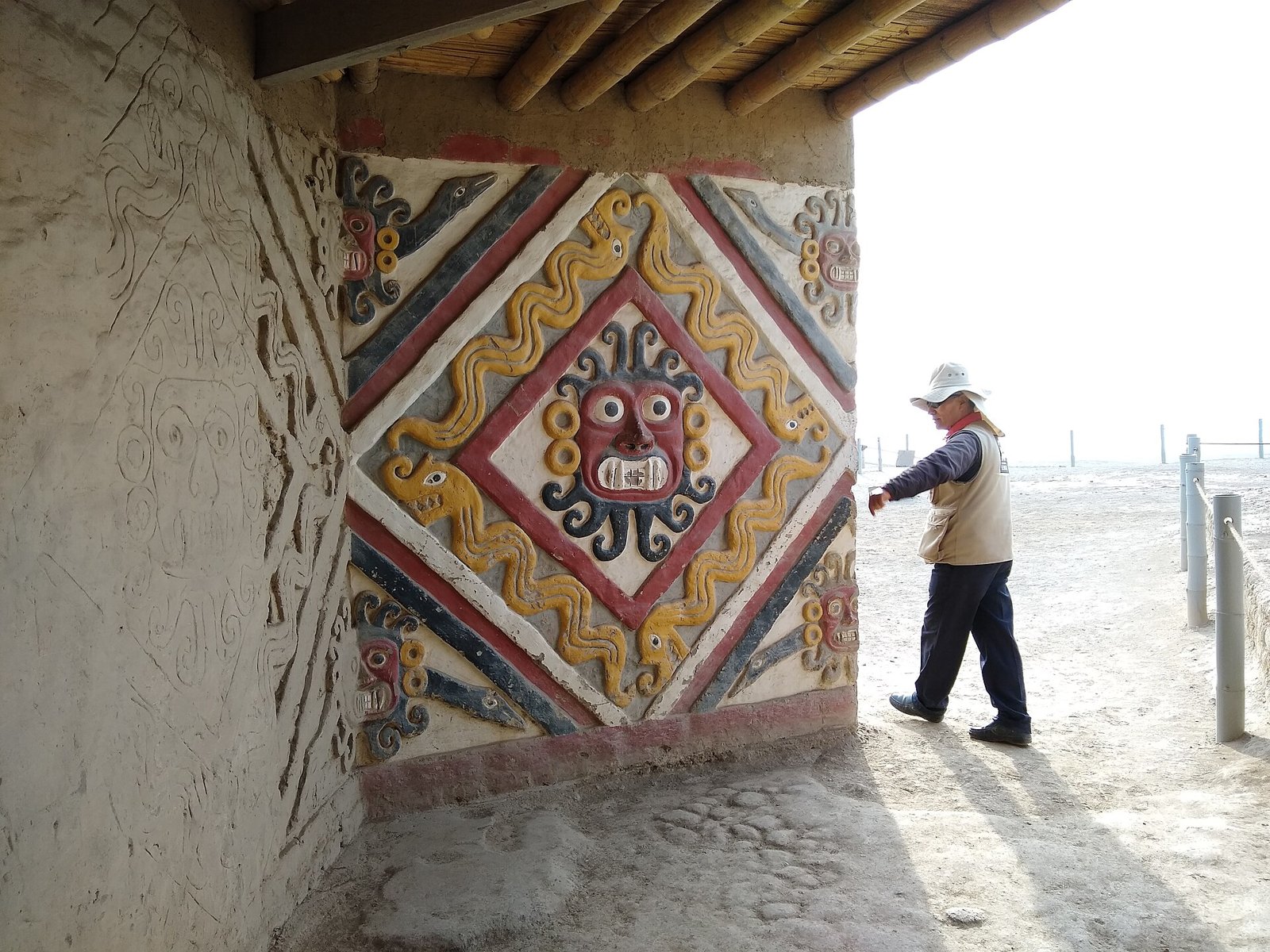
Picture a mud-brick pyramid by the Pacific, its walls covered in painted warriors and bound prisoners. Inside it, archaeologists found the tomb of a Moche woman in 2004. Today she is known as the Lady of Cao. That place is the El Brujo Archaeological Complex, on Peru’s north coast.
Below you will learn what to see, when it opens and how to reach it from Trujillo. We checked every fact against two sources: the MINCETUR tourism inventory file and the complex’s own website. One more thing: we are not the official peru.travel site. Peruvian.travel is an independent guide written for visitors.
What is the El Brujo Archaeological Complex?
According to MINCETUR, the complex sits on the right bank of the Chicama Valley, right next to the ocean. It lies in the district of Magdalena de Cao, in the province of Ascope, La Libertad. The site’s website places it about 60 km north of Trujillo.
People lived here for a very long time. In fact, MINCETUR describes about 5,000 years of continuous human presence. It starts at Huaca Prieta, around 2500 BC, and runs until the Spanish arrived. At that point, Dominican friars built a church next to a colonial town called Cao.
However, the Moche left the biggest mark. Between AD 0 and 650, they used the complex as a key ceremonial and urban center for their elites and gods. Their large adobe pyramids still dominate the landscape today.
The three huacas you will see
The complex stands on a triangular natural platform of about 1.2 km². Small coastal lagoons and farmland surround it on three sides. To the west, there is the Pacific shore and El Brujo beach.
According to the site’s FAQ, three huacas, or sacred mounds, form the heart of the visit:
- Huaca Cao Viejo: famous for its painted reliefs of Moche rituals. This is also where the Lady of Cao was found in 2004.
- Huaca Cortada: known for the deep cuts on its south face. Those cuts are more than a century old, and they gave the mound its name.
- Huaca Prieta: a pre-ceramic mound in the south part of the complex. Its story began long before 1800 BC.
Besides these, there are smaller mounds, cemeteries and old living areas from several periods. So the site feels less like one monument and more like a layered landscape.
The painted reliefs of Huaca Cao Viejo
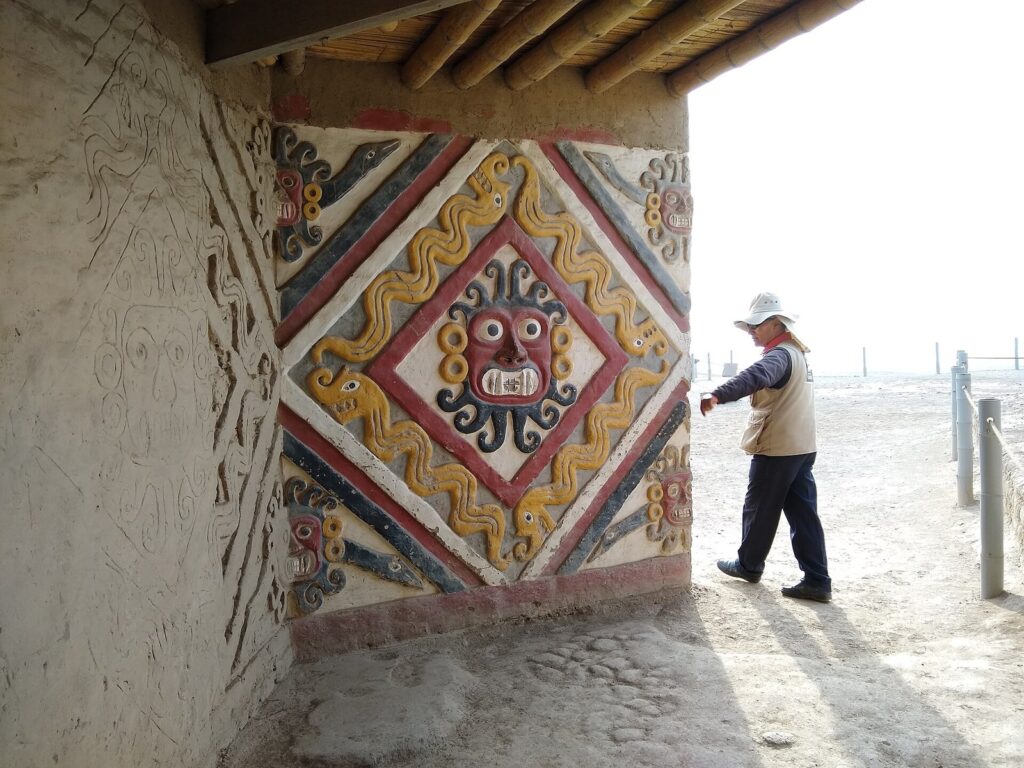
For most visitors, the reliefs are the highlight of the El Brujo Archaeological Complex. MINCETUR describes large, colorful panels on the walls of Huaca Cao Viejo. One scene shows naked men tied at the neck with a rope. Archaeologists call them “prisoners.”
The prisoners march from west to east. Behind them, several warriors follow while carrying their weapons. As a result, the wall reads almost like a parade frozen in clay.
The north side of the pyramid has another story. Looters dug many holes there to rob a large cemetery from the later Lambayeque culture. Even so, researchers have recorded more than 300 Lambayeque burials so far. According to MINCETUR, this was the first time such burials were studied in the Chicama Valley.
Who was the Lady of Cao?
The Lady of Cao was a Moche woman whose tomb was discovered in 2004 inside Huaca Cao Viejo. According to the complex, the find shed light on the role of women in Moche society. It also showed how rich and complex this culture was.
In addition, MINCETUR notes something unusual. El Brujo is the only archaeological site in Peru where a study rebuilt her facial features. The Wiese Foundation led that work, with archaeologist Régulo Franco in charge.
El Brujo Archaeological Complex at a glance
| Detail | Information |
|---|---|
| Location | Magdalena de Cao, Ascope province, La Libertad |
| Altitude | 28 m above sea level |
| Main culture | Moche (AD 0–650), with older and later layers |
| Opening hours | Every day, 9:00 am to 4:00 pm |
| Closed | December 25 and January 1 |
| Tours | Guided visits in Spanish and English |
| Facilities | Toilets, security and a viewing point |
| Managed by | Augusto N. Wiese Foundation since 1990; owned by the Ministry of Culture |
How to get to the El Brujo Archaeological Complex from Trujillo
MINCETUR describes the road trip in two legs. First, you drive or take a public bus from Trujillo to the town of Chocope. That part is 30 km on paved road and takes about one hour.
Next, you continue from Chocope to Magdalena de Cao. This leg is 4.8 km on a gravel road and takes about 25 minutes. Both a private car and a public bus are listed for each stretch.
That said, local buses work best if you speak some Spanish. On a first visit, a hired driver or a day tour from Trujillo keeps things simple. For more on buses, taxis and transfers, see how to get around Peru.
Tickets and opening hours
The complex opens every day from 9:00 am to 4:00 pm. According to its website, it closes only on December 25 and January 1. You need a ticket, and fares differ by visitor type. In addition, people with disabilities can enter free of charge.
MINCETUR lists guided visits in both Spanish and English. So you can understand the reliefs even if you do not speak Spanish.
Tips for your visit
The site sits on the open coast, only 28 m above sea level. Because of that, bring a hat, sunscreen and water. Also, take your time, since the platform is large and the reliefs deserve a close look.
Also, consider pairing El Brujo with other Moche and Chimú sites near Trujillo. Our Chan Chan first-timer’s guide is a good next step. And do not forget the paperwork: here are the entry rules for tourists visiting Peru.
Before you head out
The El Brujo Archaeological Complex joins 5,000 years of history, bright Moche reliefs and the story of the Lady of Cao. It is open daily, close to Trujillo, and offers tours in English.
If you want a longer trip around Peru, look at our 14-day Peru trip. And for Cusco and Machu Picchu, see these tour packages to Cusco and Machu Picchu.