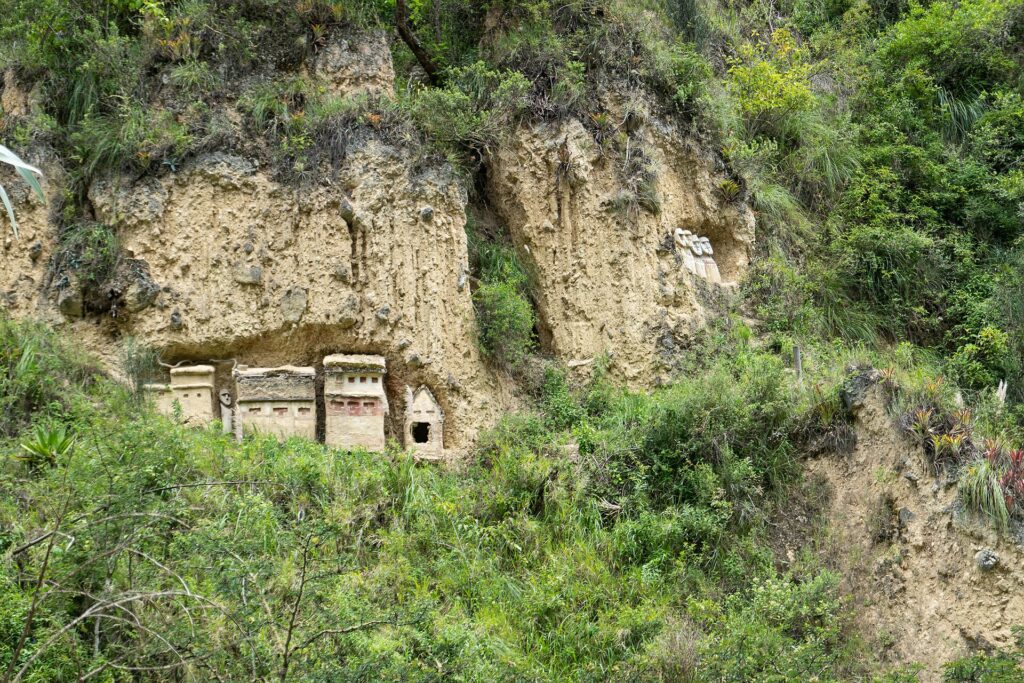
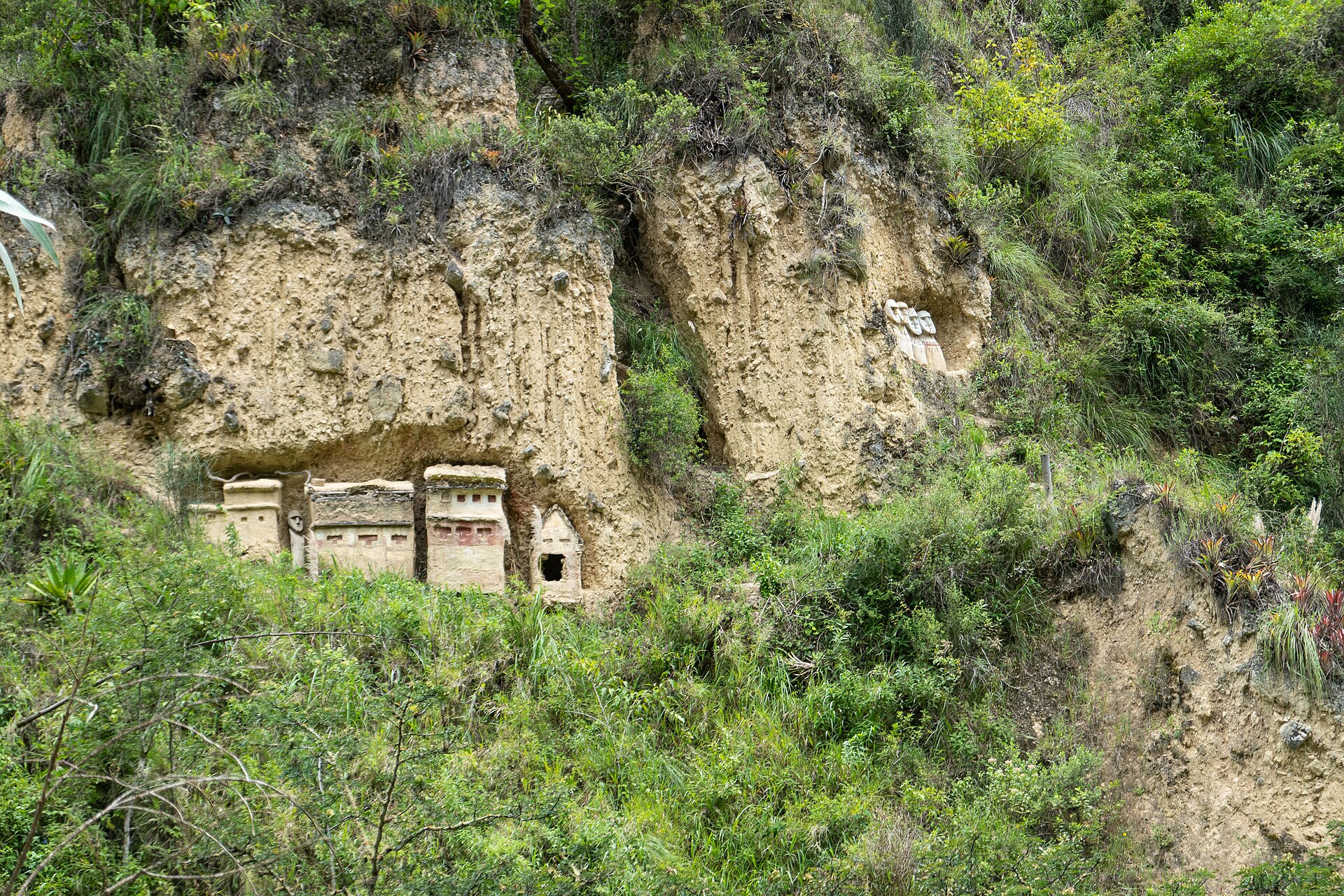
On a limestone cliff in the Amazonas mountains, a row of small cream-and-red houses looks out over a ravine. Nobody ever lived in them. They are tombs, and the place is called Revash.
Revash is a burial site of the Chachapoya people in Peru’s Amazonas region. It is less famous than Kuelap, yet it is a striking sight. Read on for the story of the tombs, the route in and a short packing list. We checked every fact with two official sources on 10 November 2026: MINCETUR’s national list of tourist sites and PromPerú’s travel portal. Please note that peruvian.travel is an independent site and is not the official peru.travel site.
What Revash is
According to MINCETUR, Revash belongs to the Chachapoya culture. This culture flourished in the Late Intermediate Period, between about 1100 and 1470 AD.
The tombs sit on ledges in an opening of a limestone cliff. Archaeologists call them mausoleums, because they look like little buildings rather than simple graves.
In fact, PromPerú notes that archaeologists see them as copies of the houses where people of the area once lived. That is why some even have pitched roofs, as if to keep off the rain.
How the Revash tombs were built
The mausoleums are split into two groups, MINCETUR explains:
- The first group has five rectangular buildings. They rise from one to three levels and reach 3.5 meters high.
- The second group has eight buildings. They have one or two levels and reach 2.5 meters high.
The walls are made of small stones set in mud mortar. Then they were plastered and painted in cream and red.
Some roofs slope one way, while others slope two ways. The second type is rare. These roofs were built with wooden logs tied with plant-fiber cords, then plastered and painted.
Also, look closely at the walls. Many tombs have niches shaped like a T, a square or a cross. Behind them, the cliff is covered with rock paintings.
What was found inside Revash
In 1948, a dig at Revash found the burial bundle of a child and the bones of eleven adults. Next to them were pieces of cloth, cords and feather ornaments.
The finds also included combs, necklaces and tools of wood and bone. There were musical instruments, pottery and a solpe, a net used for carrying loads.
Later, the Peruvian archaeologist Federico Kauffmann Doig studied the site in 1983 and 1986.
Revash at a glance
| Item | Details |
|---|---|
| Location | Santo Tomás district, Luya province, Amazonas |
| Nearest village | San Bartolo |
| Culture | Chachapoya, about 1100 to 1470 AD |
| Altitude | About 2,700 to 2,800 meters |
| Drive from Chachapoyas | About 2 hours 40 minutes to San Bartolo |
| Walk from San Bartolo | 25 to 40 minutes, depending on the source |
| Hours | 8:00 AM to 5:00 PM daily (MINCETUR) or 9:00 AM to 4:00 PM (PromPerú, reference) |
| Tickets | Sold at the Revash Tourism Association office |
Getting to Revash
PromPerú gives a simple route. First, travel from Chachapoyas to San Bartolo by bus or car, in about 2 hours 40 minutes. Then hike for about 25 minutes.
MINCETUR adds more detail if you come from Lámud, a town in Luya province:
- Lámud to the Santo Tomás bridge: 70.4 km on a paved road, about 1 hour 30 minutes.
- Santo Tomás bridge to San Bartolo: 17.6 km on a gravel road, about 45 minutes.
- San Bartolo to Revash: a 2 km trail, about 40 minutes.
If you prefer not to walk, you can ride a horse from San Bartolo to the Revash viewpoint. That stretch is 1.65 km and takes about 25 minutes. From the viewpoint, the tombs are a 10-minute walk.
Visiting Revash: hours and tickets
Tickets are sold by the Revash Tourism Association, so get yours before the walk. This community group runs the site.
As for hours, the two sources do not match. MINCETUR lists 8:00 AM to 5:00 PM every day, while PromPerú gives 9:00 AM to 4:00 PM as a reference. So plan to arrive by mid-morning to be safe.
Revash is still a quiet site. In 2023, it had 639 foreign visitors and 922 Peruvian tourists, plus 73 local day visitors.
What to do and pack for Revash
PromPerú suggests a few simple pleasures. For example, enjoy the view from the lookout point. Also, try local boiled corn, fresh potatoes and a lemon balm drink.
Then take a walk through San Bartolo, a small town with cobblestone streets.
Here is what to bring, based on PromPerú’s list:
- Sunscreen and sunglasses.
- A camera.
- Light clothes and a jacket.
- Medicine for altitude sickness, if you need it.
Temperatures range from about 11 °C to 23 °C. The site sits high, so our tips on altitude sickness in Peru may help.
Respecting the tombs
MINCETUR rates the condition of Revash as regular. The tombs are exposed to weather, rodents and birds. On top of that, there is no archaeological research program in place.
For that reason, keep to the path and never touch the walls or the paintings. Revash has been protected as National Cultural Heritage since 2003.
Where to base yourself
MINCETUR lists most services in Lámud. There you will find small hotels, restaurants and a tourist information office. You can also hire English-speaking guides.
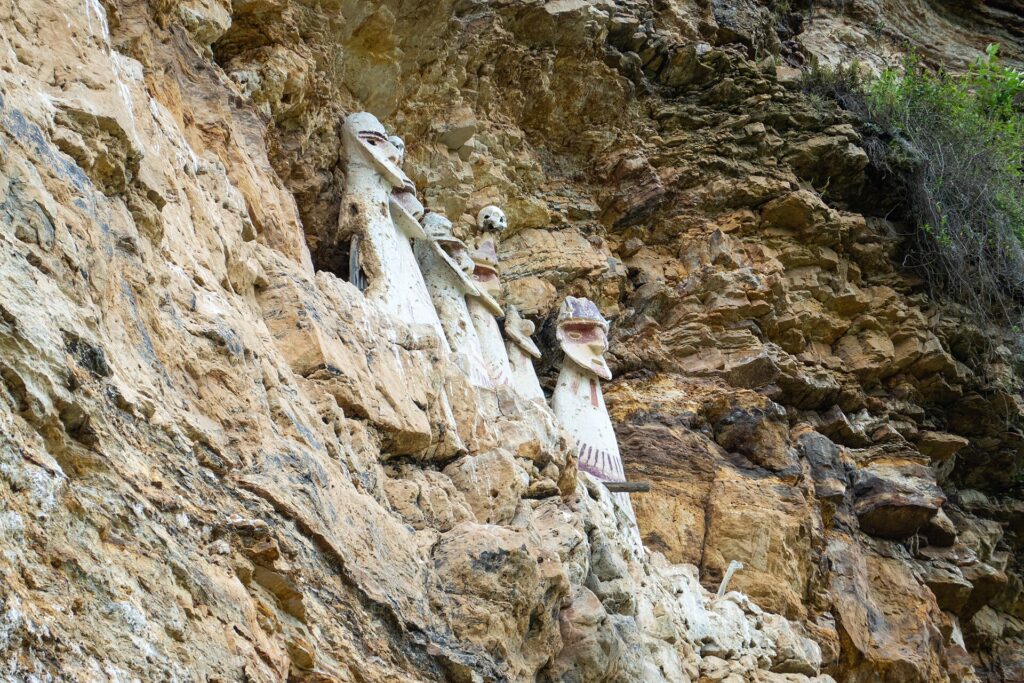
Lámud also has services for visitors to the cliff coffins of Karajía. See our Karajía guide to pair both sites. Many travelers also add the hilltop city in our Kuelap first-timer’s guide.
If you plan to see Cusco and Machu Picchu too, look at the Cusco and Machu Picchu tour packages from Fullviajes. Or, for a longer route, check our 13-day Lima, Machu Picchu and Titicaca trip.
Before you head out
Revash shows a side of the Chachapoya few visitors see: tombs built like homes, painted and roofed, on a cliff above a ravine.
So start early, buy your ticket at the association office, and pack for sun and cool air. Then walk slowly and enjoy the view.