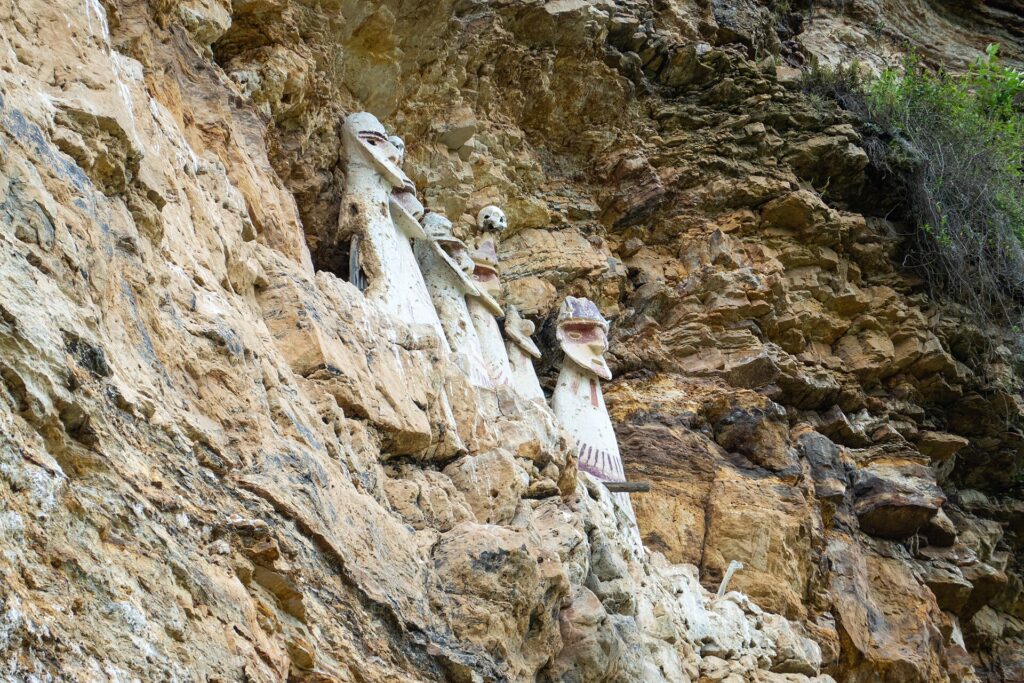
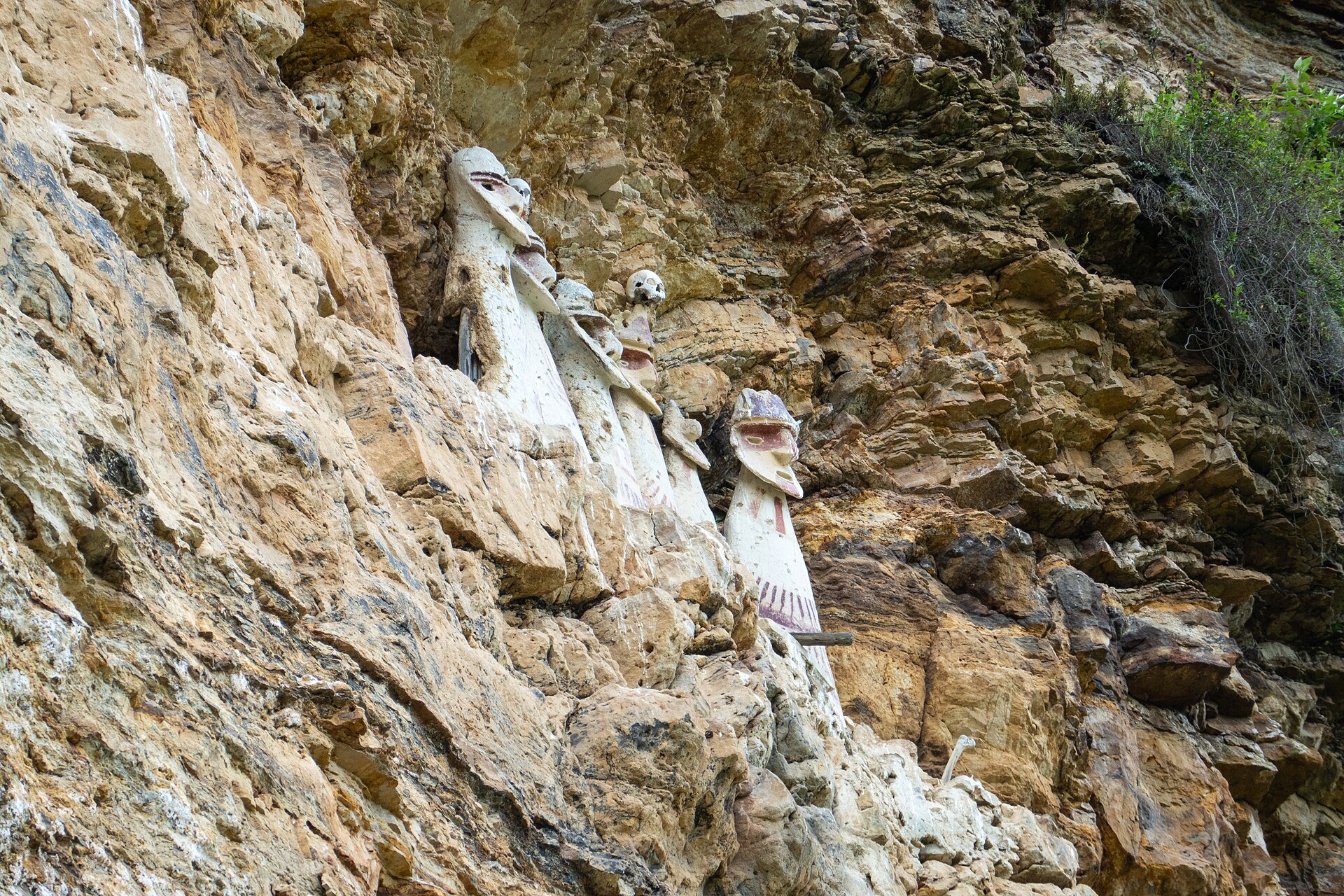
High on a cliff in northern Peru, a row of clay figures stares east. They have long faces, painted bodies and a human skull on top. These are the Karajía sarcophagi, and they have watched over the valley for centuries.
We built this guide from two official sources, checked on 9 November 2026. First, the official list of tourist sites that MINCETUR, the tourism ministry, keeps for each region. Second, PromPerú’s travel portal. Just so you know, peruvian.travel is run independently and is not the official peru.travel site.
Karajía at a glance
| Fact | Detail |
|---|---|
| Location | Trita district, Luya province, Amazonas region |
| Nearest village | San Miguel de Cruz Pata |
| Altitude | 2,713 m above sea level |
| Culture | Chachapoya, Late Intermediate Period (AD 1100–1470) |
| Hours | Every day, 8:00 am–5:30 pm, all year |
| Entry | Ticket from the local tourism association |
| Weather | About 11 °C minimum and 23 °C maximum, per PromPerú |
What the Karajía sarcophagi are
Karajía is a Chachapoya burial site. According to MINCETUR, it holds about 14 sarcophagi. They are set into a cliff on the right bank of the Solmal River. All of them face east.
Each one is a capsule for a single burial. Inside, the dead were placed with offerings. MINCETUR also notes that a group of six stands out from the rest.
Locally, the tombs are called purunmachus. MINCETUR explains that this Quechua word means “ancient man”. PromPerú adds that the figures are more than a thousand years old.
Where the name Karajía comes from
The name has a local story. According to villagers quoted by MINCETUR, “Karajía” comes from the song of a bird called kararaj. So, listen closely on the trail. You may hear where the place got its name.
Visitor numbers are solid, too. In 2025, the local log counted 7,548 Peruvian tourists and 1,003 from abroad. So, be patient at the viewpoint if you want clear photos.
How the Karajía figures were made
The sarcophagi stand on stone bases. Some reach 2.5 metres in height. That size is one reason they are so striking from below.
The shape is human. Each figure has shoulders, a head and a mask with a strong jaw. On top sits a real skull. One theory says these skulls were war trophies. However, that is still a hypothesis.
The builders used simple materials. MINCETUR lists cream-coloured clay, dry straw, cane, sticks, plant cords and stones. Then they covered the surface with red ochre and white earth. Finally, they painted faces and patterns that look like fine clothing.
Getting to Karajía
Most travellers start from Chachapoyas. PromPerú says the ride to Cruz Pata takes about 2 hours by bus or car. After that, you walk for roughly 30 minutes each way.
MINCETUR gives a more detailed route from the town of Lámud:
- Lámud to the edge of Luya. About 2 km on a paved road, around 10 minutes.
- Luya to Cruz Pata. About 20 km on a gravel road, around 45 minutes.
- Cruz Pata to the tombs. A 1.4 km trail, about 30 minutes on foot. You can also go on horseback, in about 25 minutes.
The last stretch is a rural mule trail, so wear shoes with good grip. Also, remember the altitude. If you are new to it, read our altitude sickness guide first.
Planning the long legs by bus or plane? Our article on how to travel between Peru’s regions covers the basics.
Visiting Karajía: tickets, hours and what to bring
Buy your ticket at the office of the local tourism association. That group has managed the site since 2003. MINCETUR lists the site as open every day of the year, from 8:00 am to 5:30 pm.
PromPerú suggests bringing a few basics:
- A camera.
- Insect repellent.
- Sunscreen.
- A cap or hat.
On the trail you will also see local plants. For example, MINCETUR names muña, chicory and chocho, a native lupin. There are viewpoints and signs along the way, too.
Protecting Karajía
The tombs are fragile. MINCETUR rates their condition as “regular”, because rain, rodents and birds affect them. In addition, there is no archaeological research programme at the site yet.
So, please stay on the trail and keep your distance. Never throw anything at the cliff or try to climb it. Peru declared Karajía part of its Cultural Heritage of the Nation in 2003.
Where to stay near Karajía
Lámud is the closest town with services. According to MINCETUR, it has small hotels, restaurants and craft shops. You can also find guides who speak English there.
Karajía and Kuelap both belong to the Chachapoya world. If you want to see both, read our Kuelap fortress guide.
Afterwards, if the south is calling, browse Fullviajes’ Cusco and Machu Picchu tours in English. Or, with more time, consider our 13-day plan covering Lima, Machu Picchu and Titicaca.
Before you head out
Karajía is small, but it stays with you. Few places let you look up at ancient faces that still guard their valley.
So go early, walk slowly and enjoy the view from the trail. Most of all, leave the purunmachus exactly as you found them.