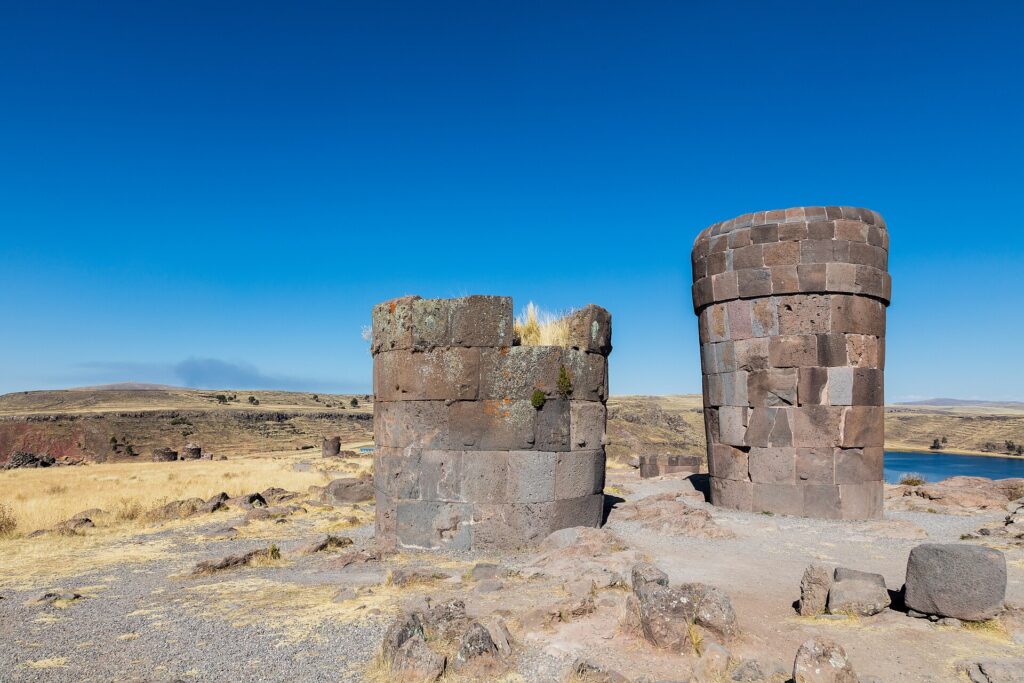
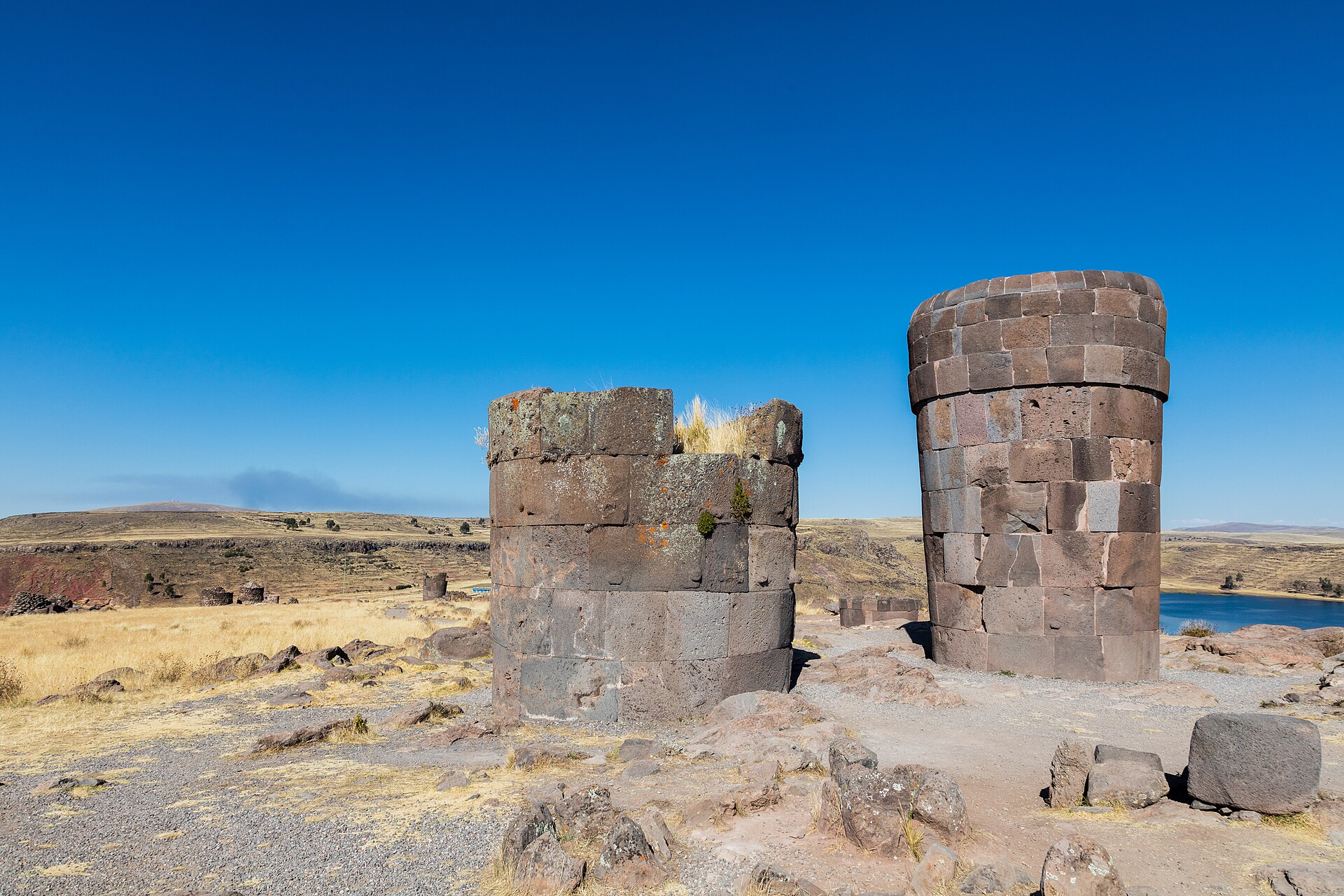
Stone towers stand on a windy hill above a quiet lake, high on the Peruvian altiplano. The tallest rises about 12 metres. Each one was a tomb for a noble of the Colla people. This is Sillustani, a short drive from Puno.
Below, you will find the history of the site, the main towers, transport options and practical tips. One quick note first: peruvian.travel is a private, independent blog and not the official peru.travel site. Every fact here is based on Peru’s Ministry of Foreign Trade and Tourism (MINCETUR), the Ministry of Culture and PromPerú.
What is Sillustani?
Sillustani is an archaeological complex in the district of Atuncolla, in the Puno region. According to MINCETUR, the Colla people built it in the 13th century, before the Incas arrived. In other words, it is a funerary site, with 91 burial towers.
These towers are called “chullpas”. Together, they cover about 60 hectares on a peninsula, right next to Lake Umayo. Peru declared the complex part of the nation’s cultural heritage in 2003.
The Ministry of Culture adds more history. Tiwanaku pottery has been found in the surrounding area. Later, the Umayo peninsula became the capital of the Colla kingdom, between about 1100 and 1450 AD.
Sillustani at a glance
| Fact | Detail |
|---|---|
| Location | Atuncolla district, Puno region |
| Distance from Puno | About 31 km, per the Ministry of Culture |
| Altitude | 3,902 m (MINCETUR) |
| Number of chullpas | 91 burial towers |
| Area | About 60 hectares |
| Opening hours | 8:30 am to 5:00 pm, all year (MINCETUR) |
| Tickets | Sold at the on-site ticket office |
| Managed by | The Ministry of Culture’s office in Puno |
| Guides | Spanish, English, French, German and Portuguese |
What to see at Sillustani
The Lizard Chullpa
First, find the most famous tower. MINCETUR calls it the chullpa of the Lizard, because a lizard is carved on one of its stone blocks. The ancient inhabitants saw the lizard as a symbol of life, since it can regrow its tail.
This tower is about 12 metres tall. Also, its base measures 7.17 metres across. As a result, it dominates the hilltop.
Three styles of tower
Next, look closely at the walls. MINCETUR describes three types of chullpa at Sillustani:
- Cut-stone towers. Smooth, polished blocks fit together with no mortar. Some are round and others are square.
- Rough-stone towers. Uncut stones sit in uneven rows, held together with mud.
- Plastered towers. These were covered with a coat of clay.
Also, notice the small doors. Every entrance faces east, toward the rising sun. According to MINCETUR, this let the dead stay in contact with the Sun god.
Burial customs
The towers held the remains of the highest Colla leaders. According to chroniclers cited by MINCETUR, bodies were mummified in a fetal position. Their belongings were placed beside them.
In fact, the Ministry of Culture says some burials also included people meant to accompany the dead into the next life. Besides, some tombs held gold, silver, food or pottery.
Ritual spaces and Lake Umayo
Besides the towers, the site has ritual areas. MINCETUR lists sun circles, stone monoliths and an entrance stairway. On the slopes you can also see old terraces and corrals.
Then, take a moment for the view. From the top, you look down on Lake Umayo. MINCETUR also lists llamas, alpacas and vizcachas among the animals you may see.
How to get to Sillustani
Sillustani lies between Puno and Juliaca. MINCETUR describes two public routes, and both use the turn-off to Atuncolla on the Puno–Juliaca highway.
| From | Route | Approximate time |
|---|---|---|
| Puno | Minibus to the Atuncolla turn-off (27 km), then combi to Atuncolla and the site car park | About 1 hour |
| Juliaca | Minibus from the Tupac Amaru combi terminal to the turn-off (24 km), then combi | About 55 minutes |
From the car park, it is a 500-metre walk to the complex. After that, the walk takes about five minutes. Another option is a guided tour from Puno. According to MINCETUR, the city has travel agencies, and guides work in five languages.
Tickets and opening hours at Sillustani
MINCETUR lists opening hours of 8:30 am to 5:00 pm, all year. Entry requires a ticket, which you buy at the ticket office on site. There are different rates for adults, students and children.
Note that PromPerú gives slightly different hours as a reference. Therefore, if you plan a late visit, check the time in Puno first.
When to visit
The site is open all year, so any month works. Still, Puno’s municipal tourism page says the dry season, from May to September, is the best time. During those months, rain is less frequent and walking is easier.
Tips for your visit to Sillustani
- Respect the altitude. At nearly 3,900 metres, walk slowly. If you are new to the Andes, read how to handle altitude in Peru before you go.
- Dress in layers. PromPerú lists warm clothing as essential, since the site sits high on the altiplano.
- Bring sun protection. PromPerú suggests sunscreen and warm clothing.
- Carry cash. Crafts and a cafeteria wait at the entrance.
- Do not climb the towers. They are protected heritage.
- Hire a guide. The stories behind each chullpa are easy to miss alone.
Add Sillustani to your Lake Titicaca trip
Sillustani pairs well with a few days on Lake Titicaca. For ideas, read our Lake Titicaca first-timers guide. In addition, PromPerú mentions a site museum nearby and boat rides on Lake Umayo.
Final word on Sillustani
Sillustani is calm, open and full of history, with a lake view at every turn. Go in the dry season, dress warmly and take your time. For official details, see the MINCETUR record for Sillustani. Finally, if you want both Machu Picchu and Titicaca, look at this two-week Peru trip with Lake Titicaca. Our partner Fullviajes also offers 4-day Cusco and Machu Picchu tours.