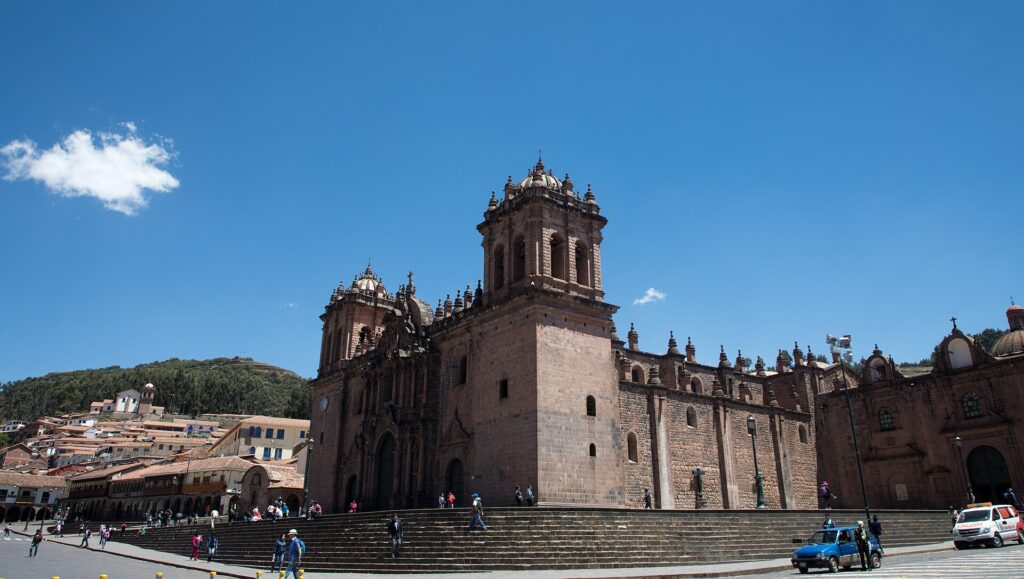
Picture Jesus and the apostles sharing a Last Supper with roasted guinea pig on the table. You can see that painting inside Cusco Cathedral, right on the main square.
This guide helps first-time visitors plan a calm, useful visit to Cusco Cathedral. It covers the history, the art worth finding and the practical details. All facts come from Peru’s official tourism inventory (MINCETUR), checked on 14 November 2026. Please note: peruvian.travel is an independent travel blog, and it is not the official peru.travel site.
What Cusco Cathedral Is
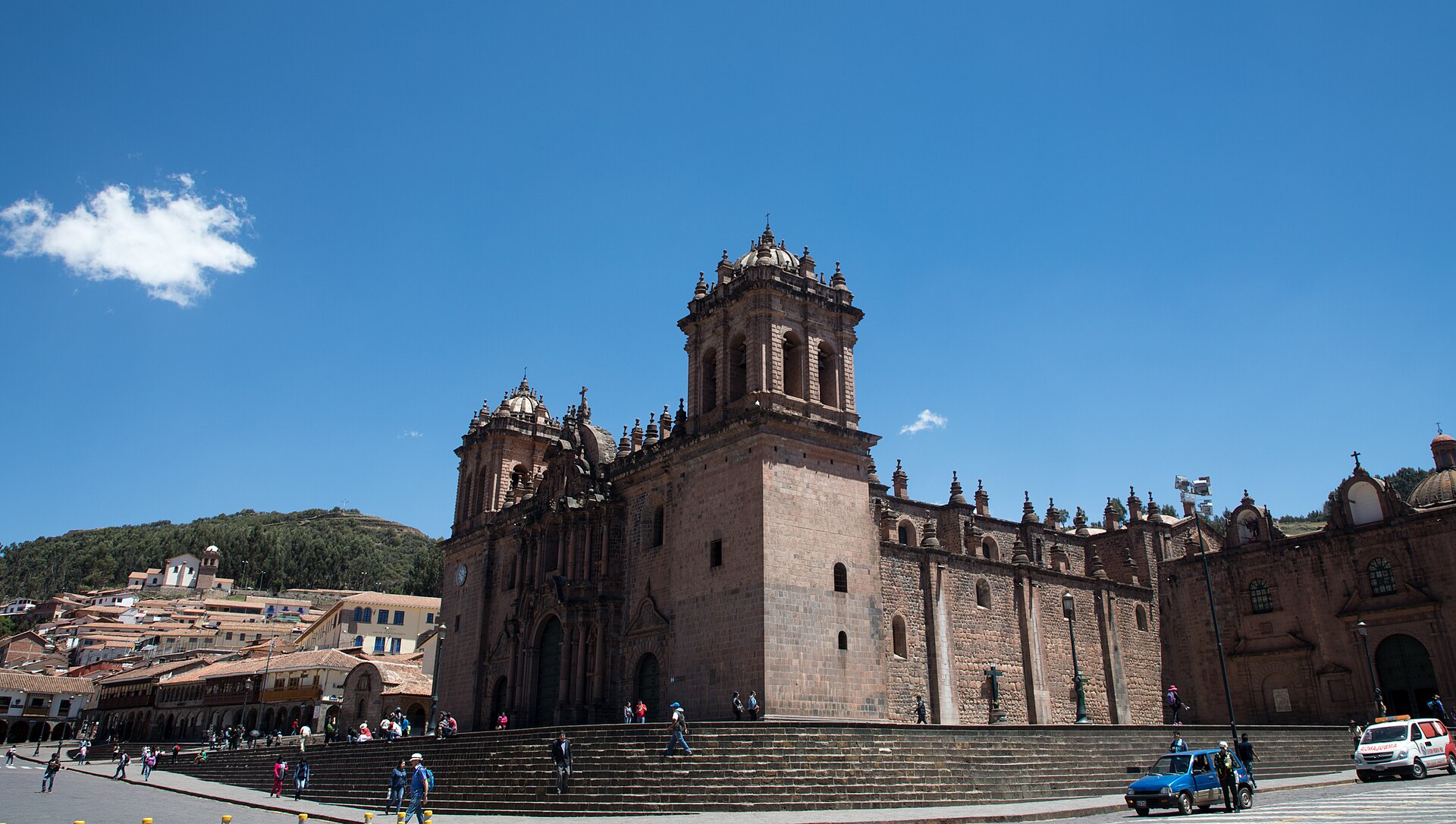
Its full name is the Cathedral Basilica of the Virgin of the Assumption. It rises over the Plaza de Armas. According to MINCETUR, it was built over the foundations of an Inca palace called Kiswarkancha.
Construction took almost a century, from 1559 to 1654. The builders used andesite and red granite. Most of that stone came from the Inca site of Sacsayhuaman, above the city.
Inside, the plan has three naves. Fourteen cross-shaped pillars hold up ribbed vaults. As a result, the building mixes several styles: Gothic, Renaissance, Baroque and Plateresque.
Peru declared it a historic monument in 1972. Then, in 1983, it became part of the Historic Centre of Cusco on the UNESCO World Heritage List.
What to See Inside Cusco Cathedral
The cathedral holds more than 300 paintings. Many belong to the Cusco School, a style of colonial art made in the city. Some were painted by unnamed Indigenous artists; others by well-known masters.
Here are the highlights the official inventory lists:
| Artwork | Artist and date | Why it stands out |
|---|---|---|
| The Last Supper | Marcos Zapata, 1753 | The meal includes guinea pig, chicha morada and rocoto peppers |
| The Zodiac | Diego Quispe Tito, 1681 | Each zodiac sign is paired with a Bible scene |
| Our Lady of Almudena | Basilio Santa Cruz, 1698 | Shows King Charles II and his queen praying |
| Litany of Loreto series | Marcos Zapata, 1755 | 50 canvases on the side naves |
| Virgin of the Little Bird | Bernardo Bitti, 16th century | The Child Jesus plays with a small bird |
| Lord of the Earthquakes | 1570 | Centre of the Holy Monday procession |
The Last Supper with local food
This is the painting most visitors look for. Marcos Zapata painted it in 1753. The table holds foods from the Andes, such as guinea pig, chicha morada and rocoto. In other words, it is a clear example of how European and Andean cultures blended.
The Lord of the Earthquakes
Locals call him Taytacha Temblores. Also, he is the centre of the city’s main religious procession. It takes place every Holy Monday. It remembers the 1650 earthquake, when people believed this Christ saved Cusco from worse damage.
Altars, pulpit and choir
Don’t rush past the woodwork. The main altarpiece is carved in cedar and covered with silver sheets. In addition, look for the finely carved pulpit and the choir stalls.
Also watch for the “arquebusier angels”. These are angels dressed as colonial soldiers, carrying old firearms. According to MINCETUR, painters José López and Leonardo Torres introduced this distinctive Cusco School theme.
Stories Hidden in Cusco Cathedral
Two details surprise many visitors. First, the cathedral keeps the Cross of the Conquest. Friar Vicente de Valverde and Captain Pedro de Candia brought it in 1533. It was used at the first Mass in Cusco.
Second, part of the ashes of the writer Inca Garcilaso de la Vega rest here. King Juan Carlos I of Spain handed them over on 25 November 1978. They lie in the crypt of the Church of El Triunfo, which is part of the cathedral complex.
Finally, remember that the cathedral connects with two side churches: El Triunfo and La Sagrada Familia. Their altars and images are part of the same artistic set.
How to Visit Cusco Cathedral
The entrance is only about 20 metres from the Plaza de Armas. So it fits easily into your first walk around the historic centre. If you just arrived, read our tips on your first day in Cusco before planning a full day.
Here is what the official inventory says about visiting:
- Opening hours: 10:00 a.m. to 6:00 p.m., year-round.
- Ticket: entry is with the Archdiocese of Cusco’s religious circuit ticket.
- Free entry: local residents with ID, and visitors during worship times.
- Guides: guiding is offered in Spanish, English, French and other languages.
Because it is a working church, dress modestly and keep your voice low. Also, keep in mind that Masses may take place during your visit.
How long to stay
The inventory gives no set visit length. Still, give yourself time to find the main paintings. A guide helps, because many details are easy to miss.
Pairing it with other sights
The cathedral works well with other stops in the centre. For example, the Qorikancha shows another layer of Inca and colonial history. Also, Cusco sits at high altitude, so take it slow. These altitude sickness tips for Peru explain what helps.
Is Cusco Cathedral Worth It for First-Timers?
Yes, if you enjoy art and history. In fact, few places show the meeting of two worlds as clearly. The stone came from an Inca fortress, while the paintings mix Bible scenes with Andean details.
If you would rather have someone handle the planning, you can browse Fullviajes’ Cusco and Machu Picchu packages. Planning two weeks? This two-week Andes route with Colca, Titicaca and Machu Picchu links Arequipa, Puno and Cusco.
Before You Head Out
Cusco Cathedral rewards slow eyes. So walk in, find the Last Supper, then look up at the vaults and the carved cedar.
After that, step back onto the square. Knowing what lies beneath it changes how the whole city looks.