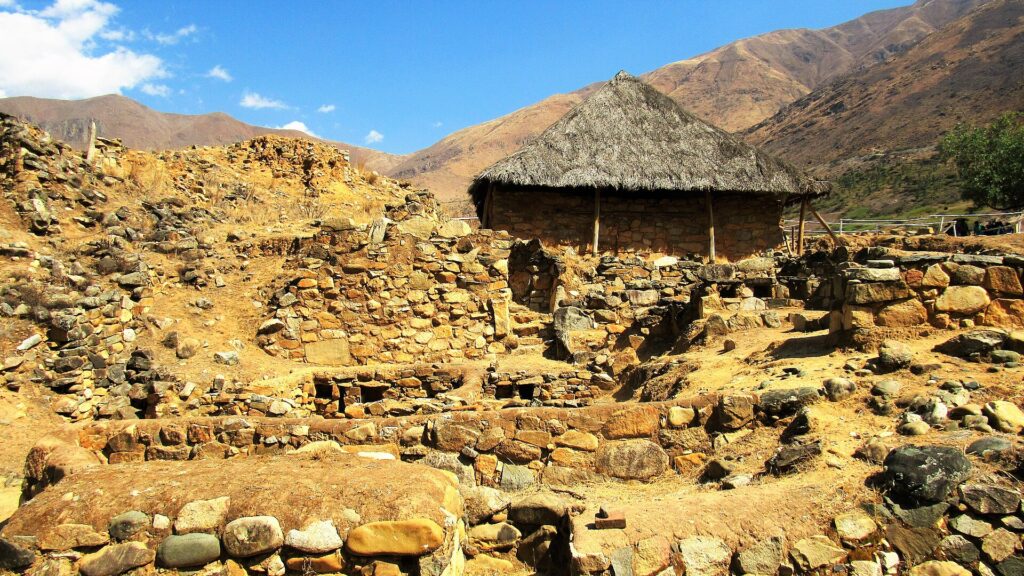
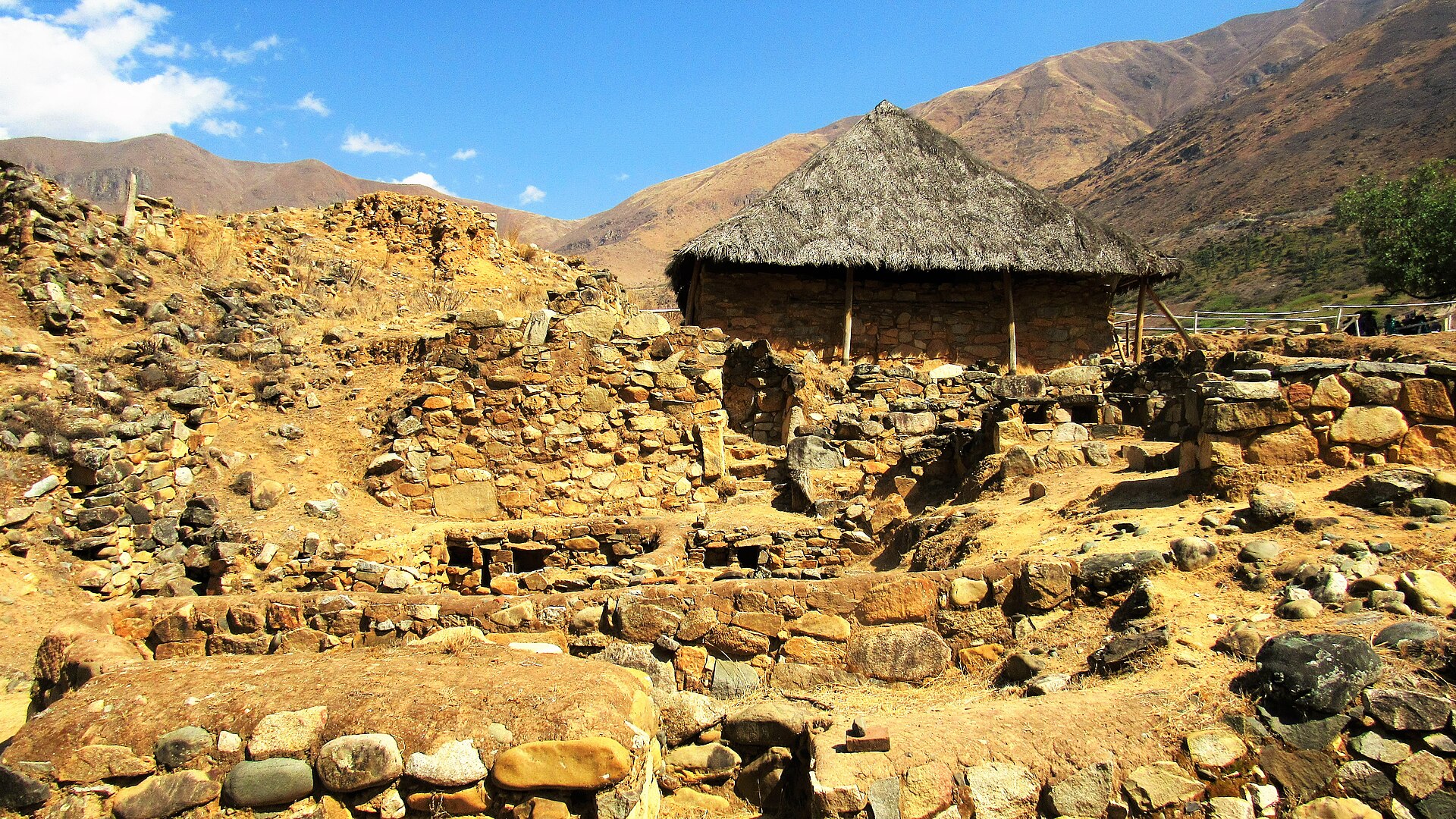
Two pairs of crossed arms, shaped in mud about 3,800 years ago, made a small hill in central Peru famous. The hill is Kotosh, just outside the city of Huánuco. Today it is one of the most important early temple sites in the Andes.
Below you will find the story of the site, the main temple and the simple ways in from the city. Before we start, this is an independent travel blog, so it is not the official peru.travel site. We verified the details with MINCETUR, the national tourism ministry, and with the Ministry of Culture.
What Kotosh is
According to MINCETUR, the word Kotosh grew out of the Quechua coto or gotosh, which means “mound” or “heap”. That fits, because the ruins form a raised mound.
According to Peru’s Ministry of Culture, Kotosh is about 4,000 years old. It is often called one of the oldest temples in Peru and the Americas. However, the ministry also notes that older temples have been found in recent years.
Even so, Kotosh remains key evidence. It shows that early Andean society was already organised around temples. Therefore, it matters for anyone curious about how civilisation began in Peru.
| Fact | Detail |
|---|---|
| Location | Huánuco province and district, central Peru |
| Altitude | 1,948 m above sea level |
| Age | About 4,000 years, per the Ministry of Culture |
| Star feature | Temple of the Crossed Hands, around 1800 BC |
| First major study | University of Tokyo mission, 1958 to 1963 |
| National heritage | Declared in 2002 |
| Opening hours | 8:00 am to 4:30 pm, all year |
| Distance from town | 5.8 km from Huánuco’s main square |
The Temple of the Crossed Hands
This is the room most visitors come for. The Ministry of Culture says it takes its name from two mud reliefs shaped like crossed arms. It dates to around 1800 BC.
MINCETUR adds that the temple belonged to the middle level of the Kotosh Mito phase. At that time, people built square ceremonial rooms of stone joined and plastered with mud. Besides the crossed hands, that phase also left the White Temple and the Temple of the Small Niches.
Six phases of Kotosh history
A Japanese team led by archaeologist Seiichi Izumi dug here from 1958 to 1963. According to MINCETUR, the team found six stages of building. Here is a short version:
- Kotosh Mito, around 2000 BC: ceremonial rooms of stone and mud.
- Kotosh Wairajirca: the first pottery style, with a semicircular main building.
- Kotosh Kotosh: rectangular and square buildings with double-faced walls.
- Kotosh Chavín: large stone and mud buildings, plastered and painted red.
- Kotosh Sajarapata, 400 to 100 BC: rectangular structures.
- Kotosh Higueras, 100 BC to AD 700: pottery styles from the Huallaga valley.
As a result, a single visit spans more than two thousand years of change. In other words, you walk across layers of buildings stacked one on top of another over many centuries. If the Chavín phase sparks your interest, read our guide to Chavín de Huántar.
How Kotosh is protected
Peru declared Kotosh national cultural heritage on 23 May 2002. Then, in recent years, the Ministry of Culture completed the legal registration of the site in favour of the state.
MINCETUR rates the site’s condition as good. In fact, the regional culture office in Huánuco carries out constant upkeep. The inventory record also lists a site museum and an information office inside the complex.
In addition, the site holds the Safe Travels stamp, awarded in 2022. For a sense of scale, the regional culture office counted 17,403 Peruvian visitors in 2021.
How to get to Kotosh from Huánuco
Kotosh lies 5.8 km from the Plaza de Armas of Huánuco, on paved road. MINCETUR lists these options:
- By car: about 15 minutes.
- By mototaxi: about 20 minutes.
- On foot by road: about 1 hour.
- On foot by trail: walk 1 km to the Heraclio Tapia León stadium, then 4.8 km on a path, in about 1 hour 15 minutes.
Hotels, guesthouses and restaurants are in Huánuco city, according to the ficha. Meanwhile, food kiosks and craft stalls sit at the entrance. For planning the longer trip to Huánuco, our guide to getting around Peru can help.
Tickets and opening hours
Entry requires a ticket sold by the Ministry of Culture. MINCETUR lists different rates for adults, university students and school pupils. The site opens all year, from 8:00 am to 4:30 pm.
Tips for first-timers
- Go in the morning, since the site closes at 4:30 pm.
- Bring water and a hat for the walk between the ruins.
- Visit the site museum first, so the phases make sense.
- Do not touch the mud reliefs; they are thousands of years old.
Also, if you want to compare Kotosh with an even older site, see our guide to Caral. And if Cusco is also on your route, Fullviajes has English-language Machu Picchu and Cusco tour packages.
Final word
Kotosh is small, quiet and close to town. Still, its crossed hands tell a big story about the first temples of the Andes.